Search for pawpaw growing advice and you'll find near-universal agreement: pawpaws need shade when young. It's in the extension bulletins, the homesteading forums, the gardening books. Pawpaw is an understory species, the reasoning goes, so protect seedlings from direct sun.
That advice isn't wrong. But it's incomplete in ways that matter — and taken literally, it leads some growers to shade their trees when they'd be better off without it.
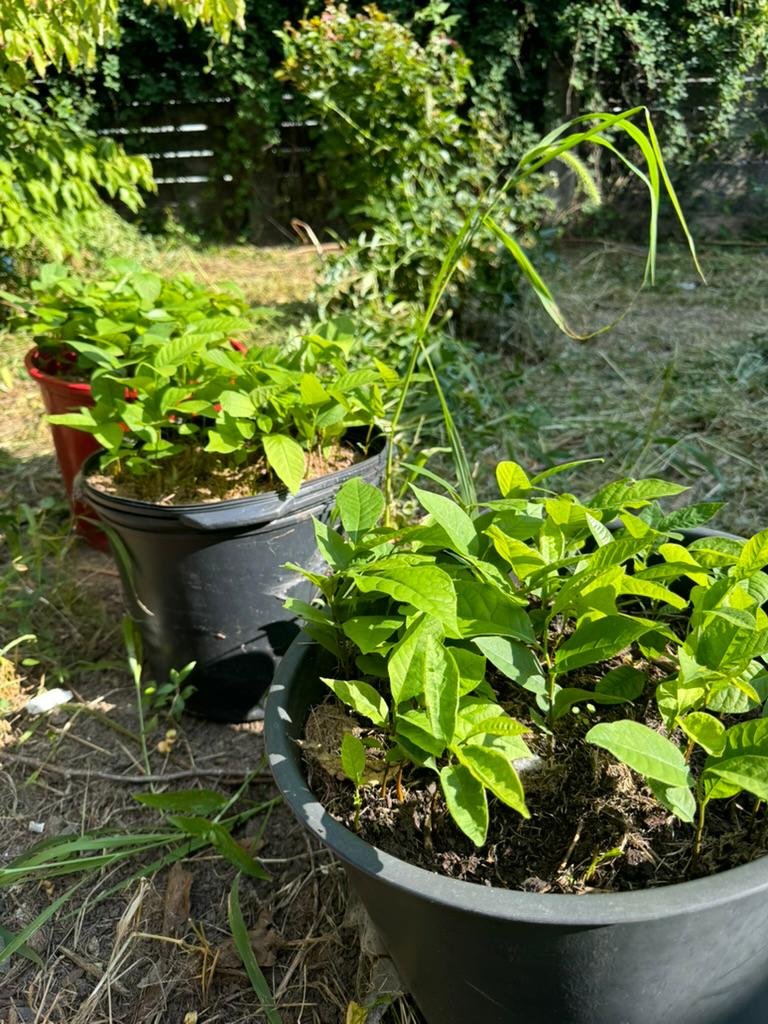
Container pawpaw seedlings growing in full direct sun at our Andreas, PA farm. No shade cloth. Consistent watering. Dense, compact growth.
Where the "Needs Shade" Advice Comes From
Pawpaw (Asimina triloba) is native to the understory of eastern deciduous forests. In that environment, it receives dappled or partial sun — 30–50% of full sunlight filtered through a forest canopy. It's adapted to grow and survive in that light level, which is what "shade tolerant" means.
The original practical advice was aimed at growers transplanting bare-root or container-grown seedlings into the open ground in summer. In that scenario, a young tree with a stressed root system trying to support full transpiration load under a blazing sky will struggle. The shade cloth recommendation was a reasonable intervention for a specific problem: root-limited transplants in hot, dry conditions.
Over time, that specific advice became a general rule: pawpaws need shade. It's applied now to situations that are fundamentally different from the original context.
Situation by Situation
| Situation | Full Sun | Shade | Recommendation |
|---|---|---|---|
| Container seedlings, spring–summer | Compact, robust growth — more nodes, thicker stems | Leggy, stretched growth — reaching for light | Full sun with consistent water |
| In-ground transplants, first year | Stress risk if root system isn't established | Reduces transpiration demand while roots establish | Partial shade for first 4–6 weeks after transplanting |
| In-ground seedlings, year 2+ | Faster growth, more energy for root and canopy development | Slower growth, can persist but won't thrive | Full sun; transition shade-grown trees gradually |
| Mature trees, fruiting phase | Heavier fruit set, better flavor development, higher yields | Will fruit but at reduced levels; heavy shade = no fruit | Full sun is strongly preferred for production |
| Natural woodland plantings | Requires woodland edge or gap — not deep shade | Tolerates partial shade; won't fruit well in deep canopy | Plant on south-facing woodland edge for best results |
What We've Seen at Andreas
We grow seedlings in black nursery containers at our farm in Andreas, PA (USDA zone 6b). We've run both approaches — shade cloth and direct sun — and the full-sun container seedlings have consistently been the better plants. Thicker stems, more compact growth habit, deeper green color, and they've transplanted into the field with higher survival rates.
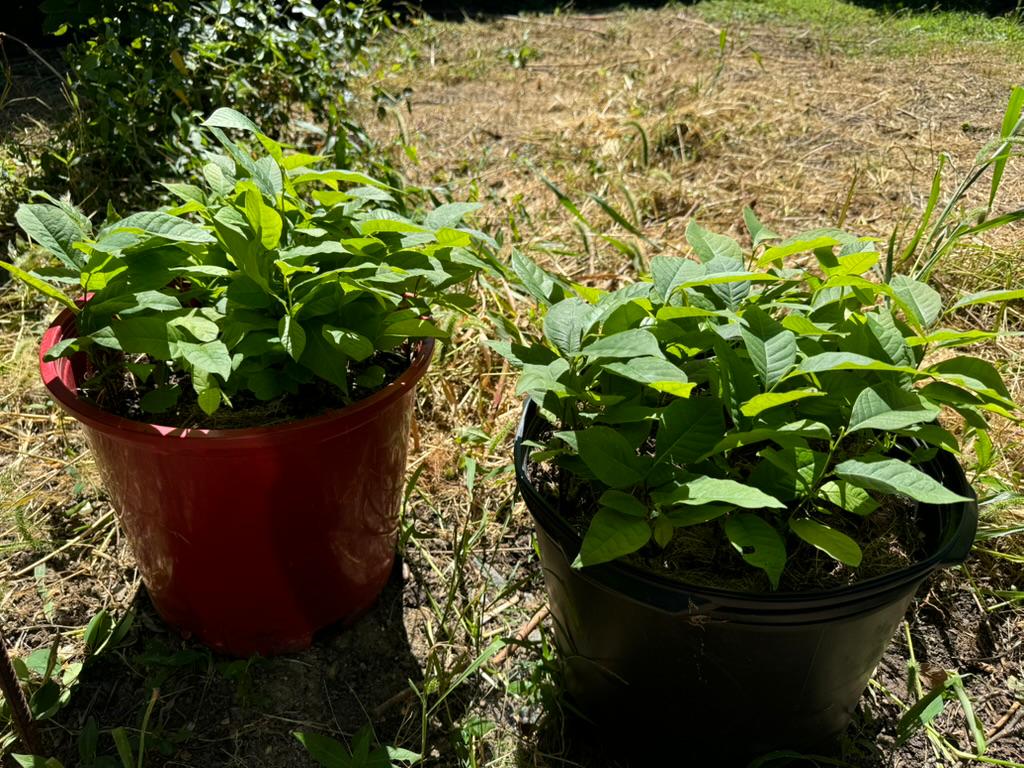
Two containers — red and black — of pawpaw seedlings in full sun at Andreas, PA. Both show strong, healthy growth across different container types.
The black containers absorb more heat, which could theoretically be a problem — but in practice the soil in those containers stays consistently moist with daily or every-other-day watering, which buffers the heat. The seedlings in the black containers performed as well as those in lighter-colored pots.
Where we do use shade: the first 3–4 weeks after transplanting bare-root or container stock into the field. That window matters. After that, we pull the shade cloth and let the trees adapt.
Why Mature Trees Fruit Better in Full Sun
Fruit production is fundamentally an energy-intensive process. The tree needs to photosynthesize enough to support canopy growth, root maintenance, and the metabolic cost of producing large, sugar-rich fruit. More light means more photosynthesis means more energy available for fruit.
- Fruit size: Full-sun trees consistently produce larger individual fruits than shade-grown trees of comparable age and size
- Fruit quantity: Flower bud formation is suppressed in low light. Trees in heavy shade may flower but set few or no fruit
- Sugar content: Full-sun ripening produces higher sugar accumulation — richer flavor, more pronounced tropical character
- Ripening time: Full-sun fruit ripens slightly earlier than shaded fruit — useful at the margins of the growing season
- Tree vigor: Full-sun trees grow faster, establish larger root systems sooner, and reach productive maturity faster than shade-grown trees
When Shade Actually Helps
To be fair to the conventional advice: shade is legitimately useful in specific situations.
- Midsummer in-ground transplants: If you're moving trees in July or August (which you generally shouldn't do, but sometimes have to), 30–40% shade cloth for 4–6 weeks protects the plant while roots re-establish
- Zone 8+ climates: In hot climates with intense afternoon sun and limited rainfall, afternoon shade protection for young trees makes sense in a way it doesn't in Pennsylvania
- Newly germinated seedlings indoors: Seedlings just emerged under grow lights or on a windowsill need a transition period before going into direct outdoor sun — harden off over 1–2 weeks rather than plunging them from indoors to full sun
- Deer pressure management: Dense shade cloth can double as deer deterrent for very young plantings — but a proper cage is better for this purpose
The Practical Summary
Container seedlings: Grow in full sun. Water consistently. You'll get stronger, more compact plants than shade-grown stock.
In-ground transplants: A few weeks of shade protection after transplanting is worthwhile. After that, transition to full sun.
Established trees: Full sun is the goal. If your trees are in heavy shade and not producing, that's likely the problem.
Pawpaw is shade tolerant, not shade preferring. There's a meaningful difference. The tree evolved the ability to survive in lower light — but given the choice, it performs better with more of it.
Related Guides
Grow Them Your Way
Pre-stratified seeds from our Pennsylvania orchard. Plant in containers, grow in full sun, water well. That's the approach we use — and it works.
Order Seeds — $15 per 10 Seeds